Wednesday, March 11, 2009

A Tiny Sun Rises

Recently, I took a trip downtown and visited the Artists on Liberty Building. There were two open galleries, one of which was by a former student of the School of the Arts. Her work was alright, though not terribly original or well-done. The other gallery, however was captivating.
Upon first entering the building, a woman walked out of what appeared to be a heavily decorated office, or perhaps a gift shop (I guess it kind of ended up being both). She was a rather rotund African American woman who smiled widely and laughed joyously at almost everything. She explained that the gallery across the street (which, I imagine she had seen me trying to enter), kept strange hours, but that we were more than welcome to look around here.
Her warmth filled the whole place with a sort of joy.
There didn't seem to be anyone in any of the offices or galleries further back into the building, so I figured I'd try hers. Why not? She was a nice lady.
Bright Caribbean colors covered the walls and some light reggae danced in the background. She told us about the featured artists, Gary Campbell, Howard Chen and Albert Harjo. Each of Gary Campbell's work was made to represent a different country of the Caribbean. There was Cuba, Haiti, The Dominican Republic and many many more. She also had postcards of his work. She said there was some confusion about whether one of his paintings was the United States or Cuba because it was of a man playing a saxophone. She figured we all should just enjoy the music. Campbell also had some abstract work that almost seemed to move it was so full of energy. That was interesting. But, as I listened to her, it was exactly the type of artwork I imagined she would collect. She sounded like any old gallery owner talking about their collection.
But then I noticed a different section of art. A group of tiny paintings (not more than a foot in either dimension) hung with each other along the wall. I stepped toward them and the woman's tone changed just slightly. She said it was artwork by Albert Harjo, a Native American man from Oklahoma who started painting in his sixties. There's some more information about him here and here(these are the only websites with any information about him). He paints using tempera and water color. I wasn't allowed to take a photograph of it myself (and as noted prior, my drawing skills are horrific), but I found some more of his work scattered throughout obscure auction websites.

His work that I find to be most beautiful is Unknown Journey.

Anonymously they walk along the cold white ground. They remind me of being a child. When I thought I could reach up into the sky and pick off a little piece of cloud to hold. Back many years ago when I read of Native Americans in children's stories. I loved them. They played with words in such imagination. Dancing through forests of wheat. Loving one another. The stories' illustrations created characters made of maybe only two or three shades of color, with little gradient between. So solid and stern. Yet they grew soft and smooth through the beauty of the writing.
I could never forget those stories.
This painting immediately sent me back there. Despite the sun's rigidity, I still imagine the softest light from all of time falling from it. Despite the intense empty space and loneliness of the composition, I couldn't help but smile at the warmth of the souls that I imagined inhabited it.
The wind seems to tug at them as if asking to play. But they can't. They must find where they're going. They're heads seem to sink down into their bodies, perhaps retreating from the cold or in shame for something bad they had done. But the sun seems to sit above them, looking down, as if in forgiveness, asking them to hold their heads high, happiness all around.
I imagine that they are returning home from a long journey, ready to fall softly into the comfort of their beds. Or maybe they're going to a village somewhere in desperate waiting for their arrival. Or maybe they've lost their home and anyone to expect them, and they're simply journeying to find a new place where they can be.
I suppose this gives quite a bit to the painting from my own personal history, but I think good art should do evoke enough of a response to entirely recreate meaning through one's past experience.

It reminds me of Chardin's, House of Cards in that they are both so simply and symmetrically composed, without very much detail in the atmosphere of this very odd little place. This, however is where the similarity of their craft ends. Harjo uses such stark, bright, wonderful blues and oranges and reds and browns in a scene that, without my personal injection of joy, is rather melancholy. But Chardin uses a color scheme rooted in soft, drab browns and greens in a scene that is sourly academic with the slightest undertone of excitement.
Though they differ quite a bit in style, they hold the same odd underlying emotion. Both make me happy. Despite the boy's manlike, stoic demeanor, his eyes have just a glimmer of excitement in them. He wants to see the house of cards stand, but he would also love to see it come crashing down in a mish-mash of suits and numbers. He has that same little spark of interest that the sun has in those journeying people. That same intimate connection with what he looks down at, what he loves.
I love Native American Art because it reminds me so of those little storybooks I used to read. That childhood exuberance that they held. I'll always associate the two, for as long as I live. I find myself too nostalgic to let them go.

Tuesday, March 10, 2009

A Presidential Redux

WARNING: This post is extremely biased. If you can't take the heat... um... don't go near hot places or things.
The world is very different now. It's flatter and closer than ever. The extreme nationalism of the Twentieth Century faded with the end of the Cold War. Anyone can connect to anyone else whenever they want. I can trade stocks on exchanges in Europe and Asia for almost nothing. As a result of this diffusion of borders, world leaders have had to evolve. They must be worldly in a way that was not always the case.
In the United States, the role of the President has also changed.

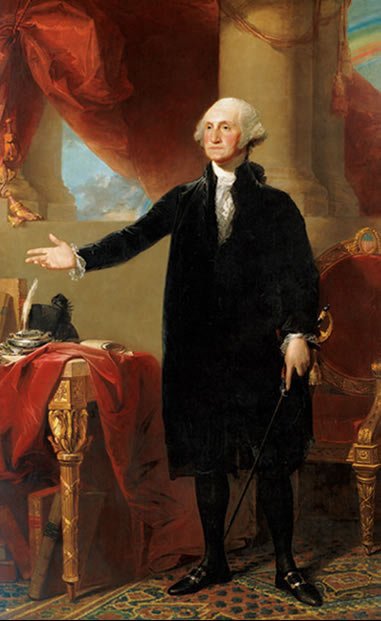
Once the President was a statesman only. Their portraits reflect this intensely. They stand or sit in ornate rooms full of incredible images of strength and power. They are stoic, sturdy, the pillar of the Nation. Washington even considered his role in government to be undemocratic. It was the Congress, he thought, that was the voice of the President. The people elect him because of his proven character and abilities in working with diplomats and other statesmen, not with garnering public support for bills or kissing babies. That was uncivilized. Presidents often didn't even campaign.

That's Andrew Jackson on the stagecoach.
It wasn't until Andrew Jackson ran for President that support for anything resembling the grassroots campaigns and public appearance that we see today began to grow. The President was, in a way, secluded from common people. He represented his country to the other heads of state, not their citizens.
But now, the President represents this country to the world. What he does reflects entirely upon the view of America in the rest of the world. Holding this position of incredible influence comes also with an incredible responsibility. He is a more public figure now than ever before. Every moment of his life is poked and prodded. We must be sure his character and personality is acceptable to be placed as the essence of what an American is.

When George W. Bush was President (legally elected only once, I might add), we were cowboys.
We shot first and asked questions later. We tortured. We were stupid. We couldn't even speak our perverted "american" english correctly. We lost the world's respect.
But then Hope happened. Barack Obama won the Presidency and suddenly there was a near religious fervor. People danced in the streets. It was time for change, for progress to finally take the reigns after eight years of BS. He was featured on the covers of some of the most prestigious magazines in the world. He was interviewed on the news, on talk shows, on the street. Story upon story upon story poured out of the media about him. His face is recognizable all over the world. He only gave his first national speech in 2004. He only became a national senator in 2004 and didn't even have time to finish a full term. Yet we know his face, his eyes, his smile, his laugh and every tone his voice can make. He is a father, a husband, a statesman, a scholar, an intellectual, a reader, a writer, a speaker, a preacher, a lover, a fighter, a friend, an idea. He became a star to rival Kennedy.


Monday, March 2, 2009

Seductive Swingers Swing Swiftly

I think dance is one of the most beautiful art forms. It comprises the composition of paintings, the dimensionality of sculpture, the intense humanity of theater, the beautiful math of music and the motion of film. It requires rigor in physicality, emotion and intellect. My love for dance likely stems from my roots in it. Both of my parents were professional ballet dancers and now are ballet teachers. It has been infused in my blood. The unfettered beauty of Swan Lake or Harbinger or any number of classical or modern ballets, speaks volumes beyond what any other art could say. They reach into your soul and fill you with what it means to be human. At least good dance does.

Somehow I have found myself rambling. My apologies.

These swinging paintings that we have looked at, in particular Jean-Honore Fragonard's The Swing, captivate a dance-like motion through the air. In The Swing, the woman's foot points toward the man, forming the graceful movement of a ballet dancer's. His hand reaches out to her with inconceivable grace. She seems as if she will fly from the swing and land softly in his outstretched arms.

He will lift her gently into the air so that she may stretch her body into a bow, her arms reaching toward heaven, her feet toward earth.

Then they will fall to the ground and embrace.

Their love is theirs.

Monday, February 23, 2009

The Landscape Conundrum

I love landscapes almost as much as I love the close up. Though the two exist at such opposite ends of the compositional spectrum, they both hold the potential to express intense beauty and undeniable power. In filmmaking, we have the opportunity to experiment with their succession and juxtaposition. Paintings have a terribly difficult time portraying both without losing the power of either. My most favorite landscapes are landscapes just. Simply composed, looking out into the world, searching for what it holds. Albrecht Altdorfer's Danube Landscape performs this task beautifully. 


Never had I seen this painting before, but when I did, it struck me so, I could not tear my eyes from it. It whispered softly to stay. To dance in the river Danube. To reach up and pick a little bit of cloud from the sky, hold it close, and never let it go.
Its forest, a mishmash of greens, leap forth from the canvas, each tree sort of muddled and indistinct, a little part of the greater whole. Each one painstakingly reaching for the sky, trying to hold on. 
The sky stands high above looking down at the world. It reaches down to the trees for companionship. Outstretching its soft clouds to lightly graze the foliage's tip. The sun peaks through just to say farewell, to wish all the world a goodnight full of wonder and warmth. It slowly falls behind the far off mountains. Rays reach out to the castle at the mountains' base to caress it, to hold it and keep it well as it listens to the river rush past, down down down to the little lake below.
All this beauty. All these things. They sit simply, softly, smoothly between two great trees who've watched this valley grow from the very smallest shrub and the very tiniest stream. To now.

Wednesday, February 18, 2009

The Terrible Tale of The Terrible Three

Due to my terrible deficiency in drawing ability, I must say that any story board, sketch or other form of hand-painted or drawn art would most likely be difficult to understand, interpret, or even discern. Here's an example of the best drawing I think I've ever done.

It required a caption so that everybody would know what it was.

As a result of said deficiency, I've written a screenplay. The story of a boy downtrodden who stands up to the terrible forces of evil that roam the playground and threaten to destroy its sanctity. A sort of modern day David and Goliath, if you will.

Here it is.


                 EXT. PLAYGROUND - DAY

                 A jungle gym rises from a rubber desert. Children play
                 all about. Some swing high into the air. Others run and
                 chase each other about. All is well.

                                         MICHAEL (V.O.)
                           Today is the day I died.

                 OVER BY A LARGE TREE

                 a group of particularly tough looking seven year-olds,
                 JIMMY, SAMMY and LENNY, lean leisurely against the tree
                 nearby. A beehive hangs on one of its upper branches.  

                                         MICHAEL (V.O.) (CONT'D)
                           These three boys made it happen. 

                 The boys watch over their domain.

                 OVER BY THE SWING SET

                 MICHAEL, a little seven year old, swings contentedly,
                 laughing and joyous. 

                                         MICHAEL (V.O.) (CONT'D)
                           That's me. How naive I was. Not a
                           care in the world. Little did I
                           know, this would be a day that
                           would live in infamy.

                 BACK BY THE BIG TREE

                 the three boys (henceforth, THE TERRIBLE THREE), swagger
                 away. As they pass by a sandbox, Jimmy takes a littler
                 kid's bucket, fills it with sand and pours it all over
                 the little kid's head.

                 The rest of the children look at Jimmy. He grins
                 threateningly.

                 The children scatter. The little boy left lying in the
                 sand. Defeated.

                 The Terrible Three continue to 

                 THE SWING SET

                 where Michael continues to swing. The Terrible Three
                 walk on over to him. There are two vacant swings left
                 on the swing set. Jimmy sits in one, Lenny on another.
                 But Sammy walks to Michael.

                                         SAMMY
                           Hey. Give me that swing.

                 Michael continues to swing.

                                         MICHAEL
                           But I'm not finished yet.

                                         SAMMY
                           So? Get off.

                 Sammy pulls on one of the chains holding up Michael's
                 swing. Sending Michael twisting away.

                                         MICHAEL
                           Hey!

                 Jimmy and Lenny laugh. Sammy doesn't respond.

                                         SAMMY
                           Get off of that swing!

                 Michael stops swinging and steadies himself.

                                         MICHAEL
                           No!

                 He starts swinging again. Sammy walks up behind him and
                 pushes him off of the swing and into the sand below.

                                         SAMMY
                           What'd you say to me?

                 Jimmy and Lenny stop swinging and hurry over to Sammy.

                                         MICHAEL
                           It's my swing!

                                         SAMMY
                           Your swing?

                 He chuckles.

                                         SAMMY (CONT'D)
                           This is our playground, friend.
                           We're the ones that say what's
                           what. And I say that this ain't
                           your swing.

                 Michael spits in Sammy's face.

                                         MICHAEL
                           Poop on you!

                 Sammy pushes Michael into the sand. A Little Girl holding
                 a ball watches nearby. Lenny notices her.

                                         LENNY
                           What are you lookin' at?

                 She runs away.

                                         SAMMY
                           You think you're some kind of a
                           tough guy, huh?

                 Michael tries to get his face out of the sand but Sammy
                 holds him down.

                                         SAMMY (CONT'D)
                           Come on boys.

                 He motions to Lenny and Jimmy.

                 The Terrible Three drag Michael behind

                 THE BIG TREE

                 and start to beat him up. 

                                         SAMMY (CONT'D)
                           You two keep watch.

                 Sammy punches Michael in the stomach. Michael tries to
                 fight back, but Sammy is too much for him. Muffled,
                 Michael cries out:

                                         MICHAEL
                           Help!

                 But his words fall to the ground, too weak to find any
                 ear to climb into. Michael submits. He's lost.
                 When Sammy finishes the beating, he pushes Michael to the
                 ground. 

                                         SAMMY
                           See ya later alligator.

                 The Terrible Three laugh maniacally and begin to walk
                 away.

                 Michael rolls over onto his back. He sees the beehive
                 dangling above The Terrible Three. 

                 With all his might, Michael finds a small rock near his
                 hand, takes it and throws it up to the hive.

                 The rock his it slightly. The nest begins to rock back
                 and forth. Bees hurry from it to see what the commotion
                 could be.

                 They spot The Terrible Three and dive right for them. It
                 is a horrific sight. 

                 The Terrible Three run away, frightened and in pain,
                 crying. 

                 Michael still lies on the ground, unable to move.

                 The little girl with the ball from before walks up to
                 him. She kneels down beside him and touches his forehead. 

                 The rest of the children from around the playground
                 scurry up to them and form a circle around Michael. 

                 They all lift him up with extreme care. The mass walks
                 back around the tree with Michael on their shoulders, 
 weakened. 

                 His eyes open carefully.

                                         MICHAEL (V.O.)
                           So there you have it. The day that
                           I died. 

                 A pause.

                                         MICHAEL (V.O.) (CONT'D)
                           Well. Almost.

                 Michael smiles.

                                                                 FADE OUT.

Monday, February 16, 2009

Self Portraits Made Easy

Think about a face. Any face. Is it your mother? Your brother? A man you've never met? A woman too old to move? Too fat? A tiny insect? A happy dog? A chimp?

Now think about a woman. Any woman. One with hands made of silk. Or one who dances and sings with joy. One that loves without reason. One that reaches for something just out of reach, every muscle working toward that desirable thing. But leave her face blank. Empty.

Now take whichever face you made at the beginning and place it upon the body of the woman you imagined. Meld her, grow her, change her so that her face and her body are connected, as one.

Imagine her soul. Can you see it in her face? Does she let you in or shut you out? Is she dark and terrible? Do you want to know her, to see her every day? Is she a friend? An enemy?

My woman dances. She moves her body intensely. Her eyes grow from an old man's. They stare with the wonder of the past and the astonishment of falling in love. Her cheeks are smooth but know well they will someday fall to wrinkles. She's a lover. Her soul slips through her eyes, but her face holds it in. There's something lost in her. Something she'll always search to find.

In looking at Judith in Caravaggio's Judith Beheading Holofernes I learn to see. The intense indefinable expression upon her face beckons to search for understanding. To find what is beneath. Her head sits so detached from the rest of her body, as if suddenly thrust into the situation. Her body has had time to adjust, but her face just had time to react. This moment is the perfect reflection of her disjointedness. Her imagination jumps instantly to something else. Searching for just what it wants. It looks elsewhere for the answer, leaving the room, her body continuing on without her. She doesn't understand. How did she get here?

Wednesday, February 11, 2009

Common Midterm Place

Places of organized worship are very odd to me. What makes any place more important than any other to a society. Especially when it has no tangible survival value. Although a person or a group of people may regard a certain plot of land as holy, what authority is there that declares it to be such for all society. 

Perhaps it is some innate sense of being that drives us to immortalize a certain spot. An instinct of sorts. Could such a thing be just as vital to the survival of our species as the instincts of the hunt? Or could it be that this is a byproduct of our consciousness, our humanness.

Whatever the reason, it is a fact that as a society, certain places, namely places of worship, are immortalized, decorated and otherwise set apart from other architectural structures. They often prescribe to a different set of creative tools. 

I visited the Memorial Reformed Church on Banner and Hollyrood. 


The architecture of red brick and white trim is classically American in nature. It expresses the south, its home. Unlike the First Baptist Church downtown, this church is not overly ornate. It blends outright decadence, mediocre artwork and simplistic design. A little of something for everyone. 

Somehow, stained glass has become a staple of western religious sites. Even my little temple back home, when it was only a couple of portables put together, had several stained glass windows. How did this come to be? In fact, churches from even the 4th and 5th centuries have windows made of colored glass and stone. Thus, stained glass has an inherent religious connotation

The most interesting part of the church was a simple corner off to the side. However strange that may sound, it's true. The corner was delicately framed between two terrible similar, modestly sized stained glass windows. Unlike many of the other stained glass windows, these two were not of some biblical scene, nor did they, due to their position, provide an enormous amount of light. Also unlike many of the other stained glass windows, these were in an area that saw just slightly less foot traffic than the rest of the church. They stood there awkwardly, somewhat forgotten.

Their design expressed no ornate desire to please, just a simple augmentation of the surrounding place. A simple blue trim that meandered up into a crown of sorts. Picturing a window within a window. They lived so that the church as a whole could be beautifully balanced. 
 
These are the windows.

The vertical lines that hold the glass present a sense of bars. What could they be keeping out? Or holding in? Perhaps they serve to protect the holy congregates from the unholy evil outside the walls of the church. Or perhaps they remind parishioners that there are many prison-like vices of the world, and that they must be controlled. 

But then there is a symbol above the "bars." Each of which hold something of significance. The left holds a crown. Perhaps to signify that god ("the king") exists above these vices or gates. He is everything and everywhere. The right holds the tablets of the ten commandments. Perhaps signifying that these holy words are higher than the vices or gates. These symbols may be ways to escape earthly pettiness and find a true peace within a higher being. After all, we need our places of worship.

Sunday, February 8, 2009

This is not for the commonplace book

This is not for the Commonplace book. I just thought it was funny.

Wednesday, February 4, 2009

You're the top.


Listen while you read.

I've always considered Michelangelo to be one of the greatest artists. To me, great art is about humanity. It is about the expression of being human. Michelangelo does this not only through his technique, but also the emotion that comes as a result. His figures have weight. Their muscles contract and relax as a real person's would. Their faces contort into human expressions.  But it is not the exactness of craft that yields greatness. It is the soul that is created behind the craft. 

When I look at his Moses, there is not a stone man sitting with a stone blanket. There is a warm bodied person sitting there before me, draped in some kind of fabric. He stares. His eyes find interest somewhere off in the distance. He runs his finger through his beard nervously. He contemplates the future of his people; of himself. Perhaps he's worried. His mind wanders through the myriad "what ifs" of his situation. Can he be all that he must? Has he done all he can? Is it worth it? Why did God choose him?

Tuesday, February 3, 2009

Leonardo DaVinci: Prankster at heart

I thought I'd get truly ridiculous with this one.

Leonardo daVinci was walking in the park one day when he saw his friend, Jim, sitting on a bench down the path.
straight chillin
Leonardo happened to have brought along a recent creation of his (an artist's rendition is pictured below).

Rock Gator
Being the trickiest fellow on the block, Leonardo thought he might play a trick on poor old Jim.

Oh no!
So he walked on over to Jim and waved "Hello."

What up.
Jim replied with a friendly hello and then asked Leonardo what he was holding behind his back.

What's behind your back?
Leonardo removed the Rock Lizard from behind his back. A sight Jim did not expect. He asked what it was.

Dude, what the hell is that?
Leonardo, disregarding Jim's question, threw the lizard at him, which flew

I can fly, too.
and landed on Jim's head.

GET OFF OF MY HEAD!
And Jim died.

I cried for Jim. Did you?
Poor Jim.

Thursday, January 29, 2009

Bosch and Me


I am a tree

lost in a lost land of lossness

stuck into a boat

floating

growing

living

from the world below me

people reap my benefits

they climb me

they sit on my brother

his branches wilt

they take us with them


I'm tied all to everything

a web of rope leaping out from me

people and things all attached along them

a man tears me apart


at my base

a lady, a monk and several seamen

sing gentle songs

to a hanging bob

sitting neatly on the end of

one of my ropes

they push a table against me

perhaps they'll lower the bob down to it

eat it

sing of its taste

feed it to the

peoplefish

that swim along the hull of the boat


row along

searching for something

perhaps a place to stow 

the seaman

that another lady

prepares to beat


the ocean becomes grass

in the distance

a mountain looks down at us

it doesn't mind our

plight

only observes

Monday, January 26, 2009

Bellini and Moms

1.
According to Kristeva, Bellini came from a family of painters.

Which would likely have a great impact upon himself as a painter. Having grown up with it as a part of his life, it likely grew to be a part of his identity.

His work benefitted and innovated the developing use of oil painting.

As Kristeva says, it gave Bellini's work a certain extra "luminous density of color" that "introduced volume into the body and into the painting."

He was the official painter for the Ducal Palace.

It gave him honor, I suppose.

I would imagine that the most shaping event in his life were the deaths of his wife and son.

It likely shifted his perspective on life quite drastically. To lose your closest loved ones, is an unimaginable experience. Perhaps his work before and after differs slightly because of this.

3.
Kristeva supposes quite a bit about DaVinci. Though she instills many facts about his life, it is still her interpretation of a man who lived hundreds of years earlier. I find her argument sound, but it still cannot be taken entirely as truth because it is based entirely upon the inference of what could have possibly maybe been the case. Nonetheless it is a very interesting perspective.

In her explanation of the Leonardo's Madonna and Child, she finds that the child seems to the purpose for the mother. She exists because he does. Chronologically (in terms of birth), this is flawed if to be taken literally. But it obviously is a more metaphorical thing than that. Her whole body turned toward the child, the real focus of the image. The baby is her goal, her superobjective. The mouth of the Madonna is also identical to that of the Mona Lisa, implying a sense of masculinity.

4.
Bellini never had a real mother or at least a female figure to fill in for that void. DaVinci had his wife, but Bellini never grew close enough to his step mother to think of her in a maternal way.

This explains the reason for the distance between the mother and child in his paintings of the Madonna.

DaVinci always has the mother completely attentive to the child, always looking and holding and pushing close to him.


But Bellini's Madonna's are less attentive to the child. They often look away to some other point of interest. They are distant to the child.


This image is strange. The Madonna looks at Jesus as if she's afraid of him, as if she is disgusted by him. She holds him as if she were a man and he were a purse. It's just incredibly awkward. It seems as though that is Bellini's idea of a mother. Distant, foreign and awkward.

6.
Kristeva asserts that the reason that the Nativity and the Crucifixion are shown so often together is their inherent connection through the mother. That the mother gave birth to Christ only so that he could die. But then is that not the case with all of us? Kristeva seems to connect that cycle of death and life as if it were a terrible thing, as if the nature of existence was wrong. Perhaps it is because Christ, as a man, is glorified in death, whereas Mary, a woman, is only glorified for her use as a vessel for the son of God. Perhaps.

8.
Between 1485 and 1499, Bellini's wife and son died. This led to a shift in his style. It becomes full of "controlled hostility or disappointment." It seems that his fatherhood is necessary "in order to relive the archaic impact of the maternal body on man." Paternity allowed Bellini to admit the threat of the maternal body as well as the separation from it. It was his fatherhood that allowed him to innovate his artwork, to grow as an artist, rather than fall victim to stagnation in his work.

Monday, January 19, 2009

Presidential Power

In this day and age, the Presidency has changed. In Washington's time, the President did as he see fit to shape and change the nation (within his power of course), rather than one who followed the will of the people. Now, the President must be an icon, a pop hero.


President George Washington


President Barack Obama.

Wednesday, January 14, 2009

Einstein's Genius

We perceive great artists as being above us, being an idea rather than a person. As such, their exploits are not simply stories, but mythologies that build the artist into something greater than a man (or woman). Their specific ability to interpret the natural world and make beauty from it makes them extremely desirable for the common man to immortalize.

I understand Albert Einstein as an artist. His work in shaping our understanding of the fundamental laws of the universe innovated the very basis of modern science. His ideas created question and searched for answers.

The key to his genius is the thought experiment. Most notably is his thought experiment of chasing a beam of light. As he chased the beam and gained more and more speed until he finally was traveling at the speed of light, the beam of light should appear to slow down until it stopped. This, both then and now, was considered an impossibility of the physical properties of light. As he thought more and more about this apparent contradiction of idea and law, Einstein eventually postulated the theory of special relativity in which the speed of light appears constant no matter the frame of reference. One of the most important scientific moments of the twentieth century.
He was 16 when he first had the thought experiment.

Sunday, January 11, 2009

The Miracle of the Lactation of St. Bernard

According to art-breastfeeding.com here There are two versions of the miracle of the Lactation of St. Bernard. The first being that Mary appeared in a prayer to St. Bernard and sprinkled some milk from her breast on his lips. This showed him that she was his mother and would help his prayers be answered by her son (Jesus). The second version is that St. Bernard fell asleep during a prayer and Mary comes to him and feeds him milk from her breast to give him the wisdom of God. So, in pictoral form.

The First Version:

Saint Bernard


was praying


when Mary


appeared


and sprinkled on his lips


some milk
from her breast


to let him know she's his mother


and that she'll help

his prayers


get to her son

Second Version:

Saint Bernard


was praying


when he fell asleep


when Mary


appeared


and started to feed him


some milk
from her breast


giving him the wisdom

of God.

So, there you have it. The miraculous lactation of St. Bernard through pictures. Hooray.